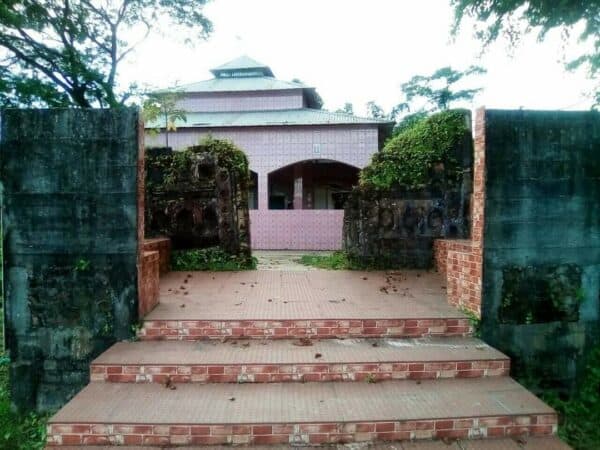
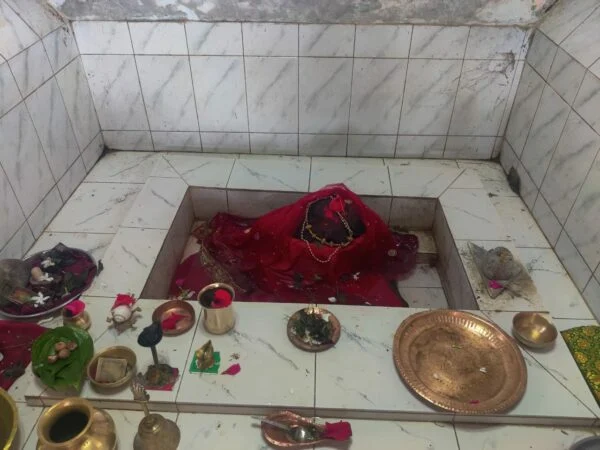
Where the philosophy of the Divine Feminine takes root in earth and stone — and the 51 Peethas form the largest sacred geography of the subcontinent.
The Shakti Peethas are a network of sacred shrines spread across the Indian subcontinent — from Kashmir to Tamil Nadu, from Sindh to Bengal, and across the modern borders of Pakistan, Bangladesh, Nepal, Sri Lanka and Tibet.
Their significance lies not in any single architectural form, but in the metaphysics they collectively represent. Each Peetha marks a place where a fragment of the Goddess Sati's body fell when Lord Shiva carried her across the cosmos. Together, they form a single living body of the Devi — distributed across geography but unified in essence.
In the Shakta tradition, visiting these shrines is more than pilgrimage. It is a reconstitution of the Goddess: walking her body, geography by geography, heart by heart.
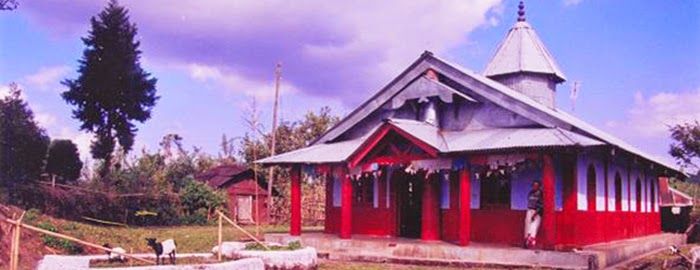
The thigh in the symbolic language of the Devi tradition signifies foundation, strength, and support. Devotees seek out Jaintia for prayers connected to courage, grounded confidence, and the long arc of life's progression.
Jaintia sits at a sacred frontier — between India and Bangladesh, between plain and hill, between Bengali and Khasi cultural worlds. It is one of the rarer Peethas where civilisational thresholds are spiritually meaningful.
Unlike many ancient sites, Jaintia has never been allowed to lapse into ruin. It is a continuously functioning sanctum with active rituals — making it spiritually "alive" in a way that adds great weight to a pilgrim's visit.
The Puranic narrative tells of Sati, daughter of Daksha Prajapati and consort of Lord Shiva. When her father organised a grand sacrifice and pointedly refused to invite Shiva, Sati attended uninvited and witnessed her husband's public dishonour. Unable to bear the insult, she immolated herself in the sacrificial fire — an act of supreme devotion and supreme protest.
Shiva's grief was the grief of the cosmos itself. He gathered her body and began the Tandava — the dance of dissolution that threatened to unmake the world. To preserve creation, Vishnu released the Sudarshan Chakra, which gradually dismembered Sati's form. As each part of her fell to earth, that place was sanctified forever as a Shakti Peetha.
The story is more than mythology. It is a metaphysical statement: that grief, devotion and divine love can permanently alter the geography of the world. The Peethas are the visible scars and blessings of that cosmic moment — including, here, at Jaintia.
"या देवी सर्वभूतेषु शक्ति-रूपेण संस्थिता।
नमस्तस्यै नमस्तस्यै नमस्तस्यै नमो नमः॥"
"To Her who abides in all beings as the power of strength — salutations, salutations, salutations again and again."
— Devi Mahatmya · Argala Stotra
In the embodied geography of the Goddess, every part of Her form carries meaning. The thigh — and especially the left thigh, associated with the lunar, the receptive, the sustaining — represents the ground of being itself.
It is the body's pillar; it bears weight, supports motion, and enables movement. Symbolically, it is what makes life's journey possible. The descent of this part of Sati at Jaintia therefore consecrates the shrine as a centre of foundational power: power for new beginnings, for resilience under pressure, and for the long unfolding of effort over time.
Pilgrims often come to Jaintia at moments of life when they require steady inner strength rather than ecstatic transformation — preparing for endeavours, beginning families, taking on long obligations, or seeking healing from prolonged trial.
Shakti is not a belief — it is the philosophical recognition that all creation is animated by a primal feminine energy, without which even the highest principles remain dormant.
Shakti is the dynamic principle of the universe — the active power without which Shiva (consciousness) cannot manifest. Every act of becoming, of creation, of growth, of nourishment, is Shakti at work.
In the Shakta vision, the Goddess pervades the three worlds and the three states of consciousness. She is simultaneously immanent in nature, transcendent in being, and intimate in personal devotion.
Beyond cosmology, the Shakta tradition reaches into a deeply personal dimension — the Goddess as Anandamayi, the Mother who is bliss itself, drawing the seeker beyond fear into joy.
The daily worship cycle includes the awakening (Mangala Aarati), midday offerings, and the evening Sandhya Aarati — sustained without break across generations.
The nine sacred nights of Navaratri are observed with special intensity at Jaintia. During Durga Puja, the temple becomes a destination for pilgrims from across South Asia and the diaspora.
Devotees come for vows undertaken at decisive moments — marriages, births, recoveries, new ventures — and for the gratitude offerings (manat) made when those vows are fulfilled.
The Shakti Peetha pilgrimage — the Shakti Peetha Yatra — is arguably the most ambitious sacred journey of the Hindu world. It crosses national borders, climate zones, language regions and political histories, binding the subcontinent into a single devotional circle.
Jaintia is one of the principal stations on this great journey. For pilgrims completing the eastern arc — including Sugandha in Bangladesh, Kamakhya in Assam, Tripura Sundari in Tripura, and Kalighat in Bengal — Jaintia is an essential and emotionally charged stop.
The Devi Bhagavata Purana enumerates the Shakti Peethas across the subcontinent, describing the body part that fell at each. It is the canonical authority for the 51-Peetha tradition that includes Jaintia.
This Tantric compendium catalogues the Peethas, their ruling deities (Devi and Bhairava), and the body parts associated with each. Jaintia's identification with the left thigh draws from this stream.
A specialised work devoted entirely to the determination of Peetha sites, the Pithanirnaya situates Jaintia among the major eastern Peethas, alongside the great shrines of Bengal and Assam.
Discover how to plan your visit and join the unbroken stream of devotees who have walked this sacred ground for centuries.